
Course:
Agriculture Form 1 (016)

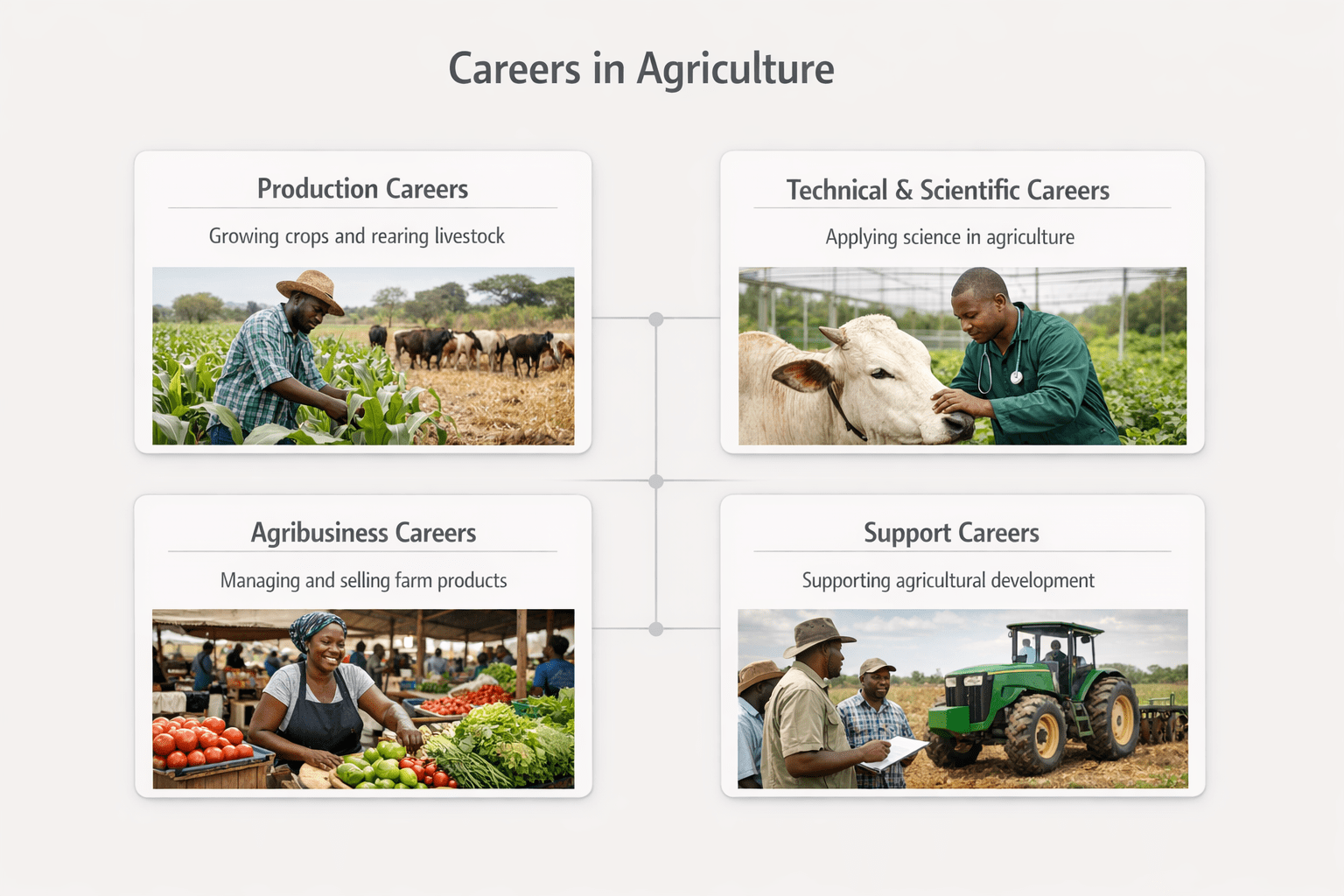
Career
Agribusiness
Training
Skills
Qualifications
Employment
Entrepreneurship
This lesson introduces learners to career opportunities in agriculture and the training required to pursue them. Learners will explore different professions within the agricultural sector and understand the entry requirements for agricultural institutions.
The lesson also highlights agriculture as both a career path and a business opportunity.
A career is a job or profession that a person trains for and works in over a long period of time.
Agriculture offers a wide range of careers:
Farmer (crop or livestock)
Farm manager
Poultry farmer
Horticulturist
Agricultural officer
Veterinarian
Animal scientist
Soil scientist
Agricultural entrepreneur
Farm produce trader
Agro-processing specialist
Agricultural consultant
Agricultural teacher
Extension officer
Machinery operator
Irrigation technician
Agriculture is not only farming—it includes science, business, and technology.
To study agriculture, learners must meet certain requirements:
Completion of junior secondary education (JCE)
Good performance in subjects such as:
Science
Mathematics
Agriculture
Senior secondary qualifications (BGCSE)
Passing relevant subjects depending on the course
Interest in farming and nature
Practical skills
Problem-solving ability
Hard work and commitment
Examples of institutions offering agricultural training include:
Agricultural colleges
Universities
Vocational training centres
Training can be:
Formal (schools, colleges)
Informal (practical experience, farming at home)
Training helps learners:
Gain knowledge and skills
Improve productivity
Use modern farming techniques
Become self-employed
Skilled farmers are more productive and successful.
Question: What is a career?
Answer: A job a person trains for and does over a long time.
Question: Name one career in agriculture.
Answer: Veterinarian.
Question: What is agribusiness?
Answer: Agriculture practiced as a business.
Question: Name one requirement for studying agriculture.
Answer: Passing science subjects.
Question: Give one skill needed in agriculture.
Answer: Problem-solving.
Question: Why is training important in agriculture?
Answer: It improves knowledge and productivity.
Agriculture offers many career opportunities
Careers include farming, science, business, and education
Entry into agricultural institutions requires academic qualifications
Training helps improve skills and productivity
Agriculture can be both a career and a business opportunity

